COCTAIL® – red-yellow park rose – Meilland
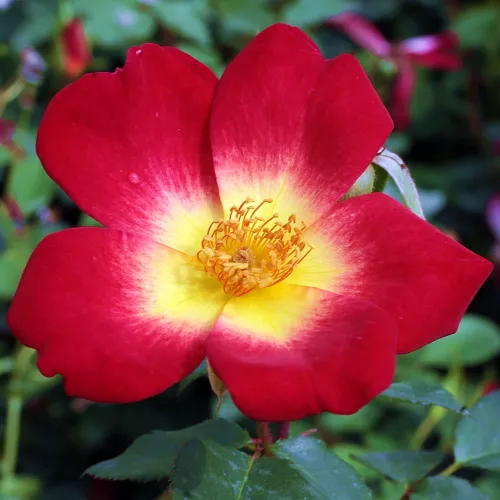
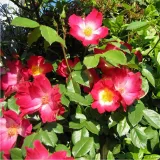
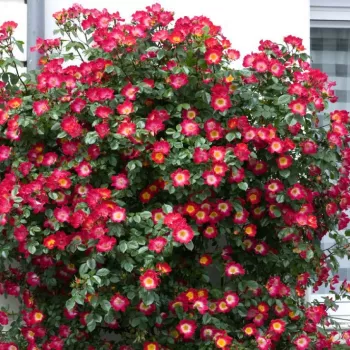
Create a romantic garden arbour with COCTAIL®, an easy-going, own-root park rose that quickly clothes pergolas, fences and walls in vivid colour. Its single, scarlet-and-gold blooms appear in generous clusters from early summer, then refresh in a lighter, second flush for a long, storybook season. Dense, dark green foliage, good self-cleaning flowers and dependable vigour make it reassuringly low-maintenance, while robust roots anchor the plant securely even where breezes test garden structures. Over time, the own-root plant builds a strong framework that regenerates reliably after pruning, supporting decades of garden character and a relaxed, cottage-like charm.
Usage options
| Target area | Reasoning |
|---|
| Arbour or pergola near a seating area |
Upright, vigorous growth makes COCTAIL® ideal for training over an arbour or pergola, quickly forming a light canopy of colour above a bench or afternoon tea table while remaining airy enough to avoid feeling enclosed, suiting romantic homeowners |
| Family garden fence or boundary |
Once established, this shrub rose forms a dense, leafy screen that softens fences and boundaries, giving reliable cover and colour without demanding complicated care routines, which fits the needs of busy families |
| Rose-and-perennial cottage border |
The simple, bi-coloured flowers sit beautifully among herbaceous perennials and traditional cottage plants, adding structure and height while its self-cleaning habit keeps borders looking fresh for cottage gardeners |
| Climbing feature in small urban gardens |
Trained against walls or on slim supports, COCTAIL® delivers vertical impact where ground space is limited, with a manageable habit and moderate maintenance needs that suit compact plots and urban gardeners |
| Long-term focal point by an entrance |
As an own-root rose, the plant develops into a resilient, long-lived framework that can be refreshed by pruning and reliably regrows from its own wood, giving lasting presence for long-term planners |
| Partially shaded side path or walkway |
Tolerating partial shade, COCTAIL® can brighten side passages or garden paths where sun is limited, its vivid blooms and glossy foliage lifting less-favoured corners for practical gardeners |
| Wind-exposed or open-position feature |
With a strong, upright framework and dense foliage, this variety stands up well in more exposed spots, its own-root system giving secure anchoring and good recovery where winds regularly test coastal gardeners |
| Large container on terrace or patio (40–50 litres+) |
In a generous container of at least 40–50 litres, COCTAIL® can be trained on a simple obelisk to bring height and colour to terraces; good self-cleaning flowers simplify upkeep, ideal for container enthusiasts |
Styling ideas
- Cottage-arch – Train COCTAIL® over a metal or timber arch with lavender and catmint at the base for a soft, English-countryside entrance – ideal for lovers of traditional cottage gardens
- Kitchen-corner – Grow it on a rustic trellis beside raised vegetable beds, underplanted with chives and marigolds to blend ornament and produce – perfect for rural kitchen-garden owners
- Storybook-bench – Place a simple wooden bench beneath a COCTAIL®-clad pergola, with foxgloves and hardy geraniums nearby, to evoke relaxed afternoon tea scenes – appealing to romantic daydreamers
- Urban-screen – Use COCTAIL® along a city fence with evergreen shrubs and ornamental grasses to soften hard boundaries while keeping maintenance straightforward – suited to time-poor urban families
- Patio-feature – In a large terracotta pot, pair COCTAIL® on an obelisk with trailing thyme and dwarf asters for a colourful, easy-care terrace focal point – attractive to balcony and patio gardeners
Technical cultivar profile
| Characteristic | Data |
|---|
| Name and registration |
COCTAIL® (MEImick), park shrub rose, also exhibited as Cocktail; shrub / floribunda type used as an ornamental climber when trained onto supports in family and public gardens. |
| Origin and breeding |
Bred by Francis Meilland, Meilland International, France; parentage (Independence × Orange Triumph) × Phyllis Bide; introduced 1957 as a vigorous, colourful park and landscape rose. |
| Awards and recognition |
Highly decorated classic: Rome Certificate 1956, Paris–Bagatelle 1st prize 1957, Orléans Gold Medal 1960, and WFRS Hall of Fame “World’s Favourite Rose” status awarded internationally in 2015. |
| Growth and structural characteristics |
Strong, upright shrub to 200–300 cm high and 120–180 cm wide, densely thorned with glossy dark green foliage; ideal for training as a light climber on arches, fences, pergolas and walls. |
| Flower morphology |
Single, flat, small flowers (around 1–1.5 inches) with 5–12 petals, borne in clusters; remontant habit with generous first flush and lighter repeat; naturally self-cleaning spent blooms. |
| Colour data and phenology |
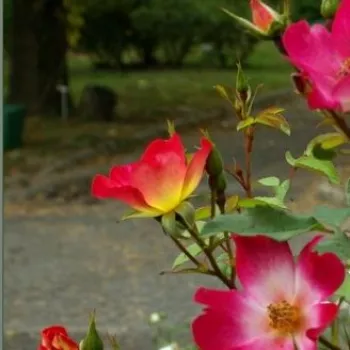
Scarlet red petals with a sharply defined golden-yellow eye; colour lightens in strong sun to salmon and pale lemon tones, creating multi-stage displays from bud to full bloom and fading. |
| Fragrance and aroma |
Very light scent with a fresh, lively character; fragrance is barely noticeable in garden use, so this cultivar is chosen primarily for its colour effect, flower form and repeat display. |
| Hip characteristics |
Forms spherical red hips, typically 7–13 mm in diameter, in moderate quantities after flowering; decorative in autumn and a useful additional seasonal feature in mixed hedges or informal plantings. |
| Resistance and winter hardiness |
Hardy to approximately −26 to −23 °C (RHS H7, Swedish Zone 4, USDA 5b); moderate resistance to black spot, rust and powdery mildew; tolerates heat yet appreciates watering in prolonged dry spells. |
| Horticultural recommendations |
Suitable for pergolas, arches, fences and walls, as specimen or mass plantings; plant about 125–210 cm apart; thrives in full sun or partial shade with reasonable soil and regular, moderate maintenance. |
COCTAIL® offers vivid, self-cleaning blooms, adaptable climbing shrub form and long-lived own-root resilience; a refined choice if you would like dependable colour with manageable care.