NICCOLO PAGANINI ® – deep red bedding floribunda rose - Meilland
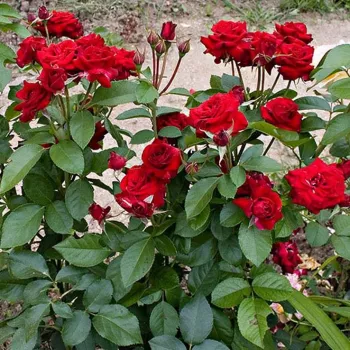
With its rich clusters of deep red blooms and compact, bushy habit, Niccolo Paganini ® brings a classic, storybook atmosphere to modest front gardens and relaxed family borders. Bred for reliable flowering, it repeats generously from early summer onwards, keeping beds and low hedges full of colour even when weekends are busy. The mid-green, glossy foliage frames each bloom beautifully, giving a well-kept look with only moderate deadheading and basic care. As an own-root plant it is naturally long-lived and capable of gentle regeneration, maintaining its shape without complicated pruning in typical British plots. Well anchored and sturdy, it stands up reassuringly to breezy conditions and coastal gusts when the garden is a little exposed. The subtly spicy fragrance suits seating areas, where you can enjoy its colour at close quarters. Over time, a thoughtfully spaced row forms a continuous low hedge line along paths or drives, while a single container specimen in a 50-litre pot adds a romantic focal accent near the kitchen door.
Usage options
| Target area |
Reasoning |
| Front-of-border bedding in a family garden |
The compact, bushy structure keeps Niccolo Paganini ® neat at the front of a border, giving a dense, colourful strip that hides bare soil without overwhelming nearby perennials, ideal for beginners. |
| Season-long colour in mixed flower beds |
Abundant, repeat clusters of deep red blooms ensure the bed never looks empty between flushes, so you can rely on steady impact from early summer with only moderate deadheading, suiting busy homeowners. |
| Low flowering hedge along a path or drive |
Regular spacing at around 35–40 cm allows plants to knit into a continuous low hedge, giving definition and privacy while remaining easy to maintain with straightforward annual trimming, perfect for family gardens. |
| Own-root planting for long-term garden plans |
The own-root form builds a durable framework and can regrow from its base after harder pruning or winter damage, supporting a long-lived, adaptable planting that suits evolving plots for long-term planners. |
| Exposed or lightly coastal gardens |
A sturdy, well-branched structure and good anchoring in the soil help the shrub cope with brisk winds and occasionally blustery, salt-tinged weather typical of open, coastal-fringe sites for UK gardeners. |
| Hot, sunny spots near patios or seating |
Good heat tolerance and moderate drought resilience mean this rose performs well in warm, reflective areas by patios, provided it is watered regularly, making it a dependable choice for urban patios. |
| Large containers and courtyard focal points |
Its compact habit and dense foliage work well in substantial containers of 40–50 litres, where the plant can establish a stable root system and flower reliably without demanding intricate care from balcony owners. |
| Romantic cottage-style combinations in heavy soils |
Planted in improved heavy clay or chalk with good drainage, it partners easily with airy perennials and grasses, creating a traditional cottage mood that matures gracefully over several seasons for cottage-garden lovers. |
Styling ideas
- Classic edging row – plant a single row along a front path at 35–40 cm spacings for a crisp, low hedge of deep red, ideal for traditional front gardens – suited to homeowners wanting an ordered, familiar look.
- Cottage tapestry – weave plants through a border with Gypsophila and Liatris for a soft, romantic mix of texture and colour – ideal for those creating an informal English cottage feel.
- Patio focal pot – grow one shrub in a 50-litre terracotta pot by a bench so the velvety blooms and light scent can be enjoyed at close quarters – perfect for small urban patios and balconies.
- Mixed-hedge rhythm – alternate this rose with low evergreen shrubs for a varied yet unified boundary, giving year-round shape and summer richness – good for families wanting structure without fuss.
- Park-style bed – mass-plant in a rectangular bed, underlining the deep red with a fringe of ornamental grasses for a smart, municipal-style effect at home – for gardeners who appreciate formal, easy-care layouts.
Technical cultivar profile
| Characteristic |
Data |
| Name and registration |
Floribunda bedding rose Niccolo Paganini ® (MEIcairma); ARS exhibition name Niccolo Paganini; the name honours Italian violinist-composer Niccolò Paganini and signals classical, dramatic garden presence. |
| Origin and breeding |
Bred by Alain Meilland, Meilland International, France, from MEIjulita × (MEIdanu × Uncle Walter); introduced and registered in 1990, combining floribunda reliability with strong colour and bedding performance. |
| Awards and recognition |
Highly regarded floribunda, honoured at Lyon in 1990 with a Gold Medal, Plus Belle Rose de France and Medal of the Great Rose of the Century, confirming its ornamental quality and bedding suitability. |
| Growth and structural characteristics |
Compact, bushy shrub 65–95 cm tall and 40–60 cm wide, with dense, mid-green, glossy foliage and moderate prickles; maintains a tidy outline for edging, mass planting and smaller gardens with limited space. |
| Flower morphology |
Medium-sized, double, cupped blooms with 26–39 petals and a defined central cone, borne in generous clusters; remontant habit ensures a strong first flush followed by plentiful repeat flowering later in the season. |
| Colour data and phenology |
Deep, velvety red flowers (ARS dr; RHS 187A–187B) open intensely coloured, darken slightly toward burgundy and fade only a little in strong sun, offering long-lasting, uniform bedding colour through repeated flushes. |
| Fragrance and aroma |
Subtly scented blooms with a mild, spicy rose character; fragrance is present but not overpowering, making it suitable near seating or windows where a light, refined scent is preferable to strong perfume. |
| Hip characteristics |
Hip set is usually sparse because of the full, double flowers; when present, hips are small, spherical, 8–12 mm in diameter and orange-red, with limited ornamental effect compared with the abundant blooming. |
| Resistance and winter hardiness |
Rated to approximately –21 to –18 °C (RHS H7; USDA 6b; Swedish zone 3); disease resistance moderate to main foliar diseases, benefiting from standard preventive care in humid or high-pressure seasons. |
| Horticultural recommendations |
Best in sunny sites with improved, well-drained soil; allow 35–60 cm spacing depending on use, water regularly in dry spells, and provide occasional deadheading and plant protection for sustained ornamental value. |
Niccolo Paganini ® offers compact habit, reliable flowering and enduring own-root resilience, making it a thoughtful choice if you would like deep red elegance in your garden with manageable, long-term care.